Australia’s recent decision on paraquat has put weed management under the microscope. As chemical restrictions tighten and resistance becomes an increasing challenge, could mechanical weed control offer the practical solution many farmers are looking for?
In short
- On 23 June 2026 the APVMA kept paraquat and diquat registered in Australia, but with much lower application rates, fewer permitted uses and tighter handling rules.
- Products with older labels can be bought and used only until 22 June 2028.
- Mechanical weed control, such as a BROOKFIELD® ChainBar pass before seeding, gives growers a non-chemical option that also helps slow herbicide resistance.
What are the new APVMA paraquat and diquat restrictions?
Paraquat and diquat are non-selective knockdown herbicides. Australian growers have long used them to control weeds before sowing, often as the second spray in a “double knock” after glyphosate. Following a review spanning almost three decades, the Australian Pesticides and Veterinary Medicines Authority (APVMA) published its final decision on 23 June 2026. Both herbicides remain available, but under significantly tighter conditions:
- Lower rates: the overall maximum application rate falls from 1,150 grams per hectare to 231 grams per hectare.
- No backpack spraying: paraquat and diquat can no longer be applied with backpack sprayers.
- Enclosed handling: enclosed mixing and loading systems are required for all ongoing uses.
- Fewer uses: a number of crop uses, including vineyards, have been removed from product labels.
- Label phase-out: products with labels approved before 23 June 2026 can no longer be manufactured, and existing stock can be bought and used only until 22 June 2028. Revised labels carry “RV2026” next to the APVMA approval number.
The APVMA found that the weight of evidence does not show paraquat exposure through approved uses increases the risk of developing Parkinson's disease. Parkinson's Australia disputes this finding and continues to campaign for a ban, noting that around 70 countries, including the European Union, the United Kingdom and China, have banned paraquat. In September 2026 the Senate also agreed to hold an inquiry into the decision. Always check the current product label before use. The full details are in the APVMA's announcement.
Why are Australian farmers reducing their reliance on herbicides?
For many Australian growers, the announcement is another reminder that farming is always changing and always challenging, according to Craig Wallace, Managing Director of Active Group, which owns Brookfield Agriculture.
“Whether driven by regulation, rising chemical costs, herbicide resistance, consumer demand or greater scrutiny around environmental and workplace safety issues, producers are increasingly looking beyond chemicals and investing in long-term weed management strategies,” Craig said. “One solution continues to gain momentum and that is mechanical weed control.
“For decades, herbicides have been an important part of Australian farming. But reliance on chemical weed control alone has become increasingly difficult. Growers today face a litany of challenges in relation to chemical use and increasing restrictions is a key concern for most.
“The recent paraquat decision doesn't necessarily remove a valuable tool from growers' toolkits, but it reinforces the importance of having alternatives available. More and more farmers are contemplating how they can reduce reliance on chemicals.”
What is modern mechanical weed control?
Mechanical weed control means removing weeds physically, by cutting, uprooting or burying them, instead of spraying them. It has evolved well beyond traditional cultivation.
“Today's equipment allows growers to effectively manage weeds while preserving soil structure, reducing chemical inputs and improving operational flexibility across a wide range of farming systems,” Craig said.
“Inter-row cultivators, precision guidance technology and camera-assisted systems now make mechanical weed control a practical solution for broadacre, horticultural and organic operations alike.
“Instead of simply replacing one herbicide with another, growers can adopt a system that tackles weeds physically, reducing pressure on chemical programs while helping to slow the development of herbicide resistance.”
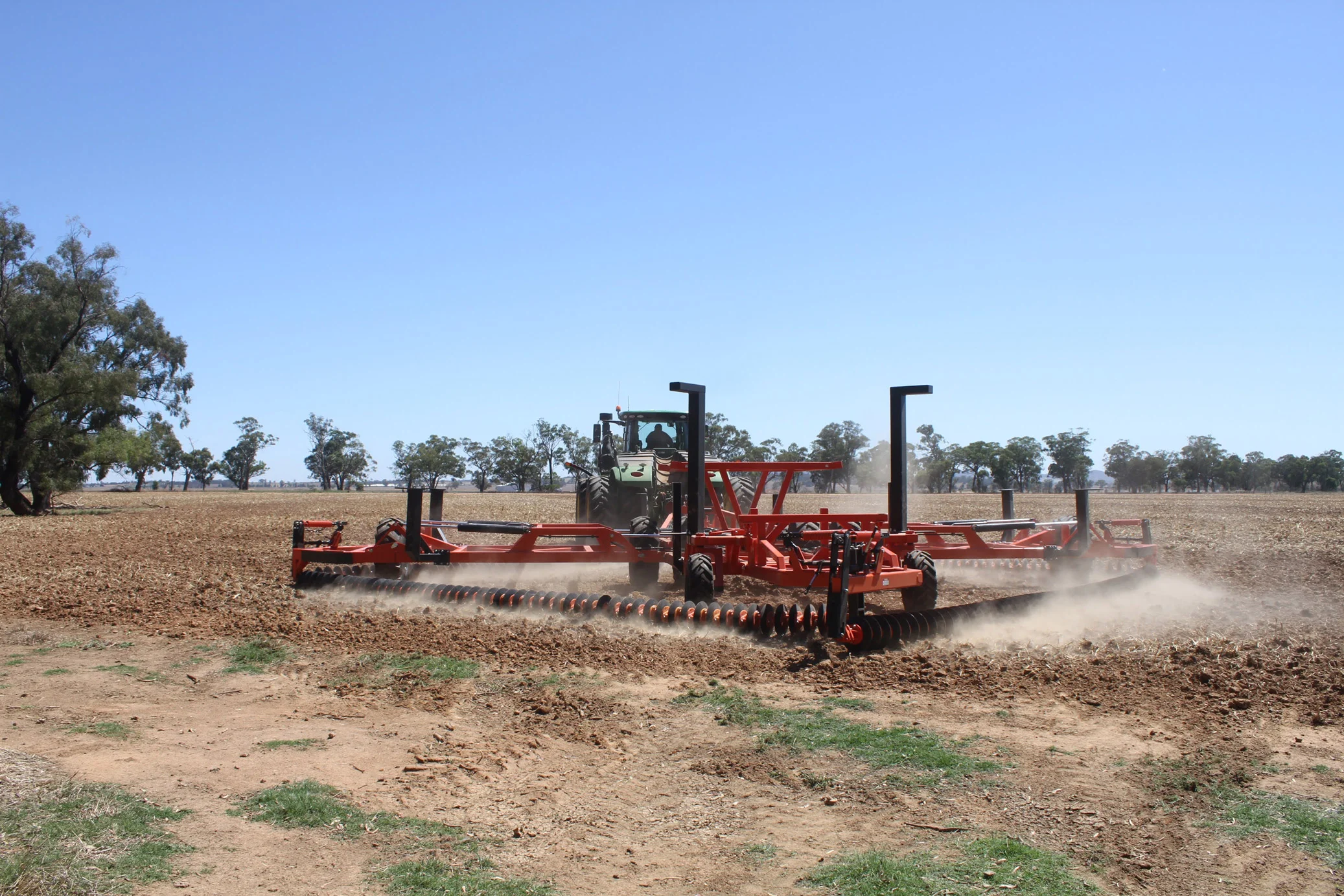
In broadacre systems, the BROOKFIELD® ChainBar fills this role as a full-width pass between harvest and sowing. It controls summer and pre-sowing weeds while also managing stubble and preparing the seedbed.
How does mechanical weed control fit into integrated weed management?
Integrated weed management (IWM) combines several control tactics, including chemical, mechanical, cultural and harvest-time methods, so weed control never depends on a single method. Mechanical control adds a tactic that works regardless of a weed's herbicide resistance.
“Mechanical weed control isn't about eliminating chemicals overnight,” Craig said. “For many Australian farmers, it's about building resilience. As regulations continue to evolve, having multiple weed control options gives farmers greater confidence and flexibility.”
Integrating mechanical weed control into existing farming operations allows producers to:
- Reduce overall herbicide use.
- Diversify weed management strategies.
- Improve long-term sustainability.
- Reduce exposure to changing regulations.
- Lower dependence on a single weed control method.
How is Brookfield helping farmers prepare for what's next?
“At Brookfield, we've long believed the future of weed control isn't about choosing between chemicals or machinery – it's about giving Australian farmers more options overall,” Craig said.
“The latest paraquat restrictions are another signal that farming is entering a new era where integrated weed management will become increasingly important.
“Mechanical weed control provides growers with a practical, proven way to reduce chemical dependence while maintaining productivity and protecting long-term soil health.
“Whether you're responding to changing regulations, managing herbicide resistance or simply looking to future-proof your farming operation, now is the time to explore what modern mechanical weed control can offer.”
How effective is the BROOKFIELD® ChainBar for weed control?
Brookfield supplies mechanical weed control solutions designed for Australian conditions. The Brookfield team works with growers across broadacre, horticulture and specialty crops to help build more sustainable, productive farming systems.
“We’ve been seeing outstanding results with the BROOKFIELD® ChainBar, with growers reporting weed kill results of up to 100 percent in recent years,” Craig said. “In comparison, we see chemical kill rates of around 70 to 80 percent. In our experience, the ChainBar can also cost around half as much to run as a chemical application.”
These figures reflect Brookfield and customer experience in the paddock. Results vary with weed species, weed size, soil type, moisture and seasonal conditions, so talk to the Brookfield team about what to expect in your district. You can also read grower testimonials.
A typical two-pass ChainBar program for weed-free sowing looks like this:
- Summer pass: run the ChainBar fitted with the Continuous Cutting Edge Disc Chain to control existing weeds and stimulate the weed seedbank to germinate early.
- Pre-seeding pass: once that flush has emerged, make a second pass before seeding to remove it.
- Sow: seed into a clean seedbed without paying for a knockdown herbicide application.
Which ChainBar chain suits your soil and system?
Six versatile chain options suit different soil types and jobs across the BROOKFIELD® ChainBar range. Weight can be added or removed quickly in the paddock, so the chains can be used in zero, minimum and even maximum tillage systems.
Options include the Prickle Chain, Dog Leg Chain, DC60 Rigid Flex, Continuous Cutting Edge range (CCE – CD5 and LD6) and Knuckle Chain. The ChainBar is available in working widths from 4 m to 18.5 m and operates at a 45-degree working angle. Narrow disc spacing achieves complete cut-out across the full width of the ChainBar.
What else can the BROOKFIELD® ChainBar do?
- Stubble incorporation: knock down and mulch stubble from wheat, canola, sorghum, sunflower and corn.
- Weed control: reduce chemical use and weed management costs with targeted mechanical control.
- Soil improvement: conserve moisture, protect the soil and boost microbial activity.
- Seedbed preparation: give crops the ideal start with a well-prepared seedbed.
- Chemical incorporation: incorporate herbicides and fertilisers into the soil.
- Paddock levelling: level paddocks and prepare a consistent surface for even establishment and higher yields.
Contact Brookfield today to discover how mechanical weed control can become an integral part of your weed management strategy. Call Brookfield on 1800 774 274, request a free ChainBar demo or find your nearest dealer.
Download the BROOKFIELD® ChainBar brochure.
Frequently asked questions
Is paraquat banned in Australia?
No. In June 2026 the APVMA decided paraquat and diquat would stay registered in Australia, but with significant new restrictions on application rates and permitted uses. Products with older labels are being phased out over two years, until 22 June 2028.
What did the APVMA decide about paraquat and diquat?
On 23 June 2026 the APVMA cut the overall maximum application rate from 1,150 to 231 grams per hectare, banned use with backpack sprayers, required enclosed mixing and loading systems, and removed a number of crop uses, including vineyards, from labels.
What are the alternatives to paraquat for knockdown weed control?
Alternatives include other registered knockdown herbicides, and non-chemical tactics such as mechanical weed control, harvest weed seed control, crop competition and strategic tillage. Mechanical tools like the BROOKFIELD® ChainBar control weeds physically, so they can replace or reduce some chemical passes.
Does mechanical weed control help with herbicide resistance?
Yes. Herbicide resistance develops when the same chemical modes of action are used repeatedly. Controlling weeds physically adds a non-chemical tactic to an integrated weed management program, reducing selection pressure on herbicides and helping to slow resistance.
How does the BROOKFIELD® ChainBar control weeds?
The ChainBar drags heavy chains, such as the Continuous Cutting Edge Disc Chain, across the paddock at a 45-degree angle. The discs cut and uproot weeds across the full working width while also mulching stubble and levelling the soil surface.
When is the best time to run a ChainBar pass for weed control?
An initial summer pass encourages weeds to germinate early. A second pass before seeding then removes that flush, so the crop can be sown into a clean seedbed without a knockdown herbicide application.
Sources: APVMA – review finds new restrictions necessary for paraquat and diquat herbicides (23 June 2026); ABC Rural (23 June 2026); Parkinson's Australia (23 June 2026).